
A deck looks like it needs replacing. The old boards come off, and underneath, the framing where the deck connects to the house is rotten.
What looked like a straightforward deck replacement has become a more involved repair.
We've seen similar problems in basements with poor drainage and bathrooms where water damage has been hidden beneath the finishes. Often, the full extent of the problem isn't clear until demolition begins.
These are the kinds of discoveries that can change the scope of a renovation.
Not every surprise can be prevented. But many of the problems that make renovations stressful can be reduced through better planning, realistic expectations and experienced construction management.
If you’re planning a home renovation in the Comox Valley or Campbell River, here are seven decisions worth making before construction begins.

1. Define What You Want Your Renovation to Accomplish
Before choosing cabinets, flooring or fixtures, ask yourself: What’s not working in this space?
Maybe your kitchen feels cramped because of its layout, not its size. Maybe your bathroom needs better ventilation more urgently than new tile. Or perhaps removing a wall would improve how your family uses the entire main floor.
Think about which problems affect your daily life the most, and prioritize the changes that would make the biggest difference.
You don't need to know exactly what your home renovation should look like to solve them. A good general contractor can help translate those needs into practical solutions, assess what's feasible and determine what work is required.
Those conversations should eventually become a clear, mutually agreed-upon scope of work, documented as part of your renovation contract. The Canadian Home Builders’ Association (CHBA) recommends written contracts that define the work, materials, exclusions and procedures for changes. This establishes what both parties have agreed to and how changes will be handled.
Before you begin: Identify the three biggest problems you want your renovation to solve. When contacting contractors, describe those problems, your desired outcome and your approximate budget. Bring those priorities to your first site visit.
2. How to Budget for a Home Renovation
If you've searched online for the average cost of a kitchen or bathroom renovation in BC, you've probably found a wide range of numbers.
There's a reason for that.
Online renovation cost calculators generally rely on assumptions about room size, materials and the work involved. They can't inspect your home or account for every design choice.
Two bathrooms of the same size can have very different renovation costs. One might need new fixtures and finishes. Another might require plumbing relocation, structural changes and a completely different layout.
What Actually Drives Renovation Costs?
The scope of work. There's a significant difference between updating the finishes in a room and changing its layout or structure. Removing walls, altering framing or rebuilding a space from the studs involves considerably more work than a cosmetic refresh.
Plumbing and electrical changes. Keeping sinks, toilets and appliances in their existing locations can reduce the amount of work required. Moving them may involve additional plumbing, electrical, framing and finishing work.
Materials and finishes. Stock cabinetry and standard fixtures can be considerably less expensive than custom millwork, specialty tile or high-end finishes. These choices can have a substantial impact on the overall budget.
Labour and project logistics. The number of trades involved, site accessibility, project complexity and local labour rates all influence costs. That's why renovation prices published for the mainland won't necessarily reflect what a comparable project costs in the Comox Valley or Campbell River.
A meaningful estimate needs to reflect the actual scope of work, not just square footage. A good general contractor can help you understand where your budget will have the greatest impact. They can explain the cost implications of different layouts, materials and construction methods, suggest alternatives where appropriate, and help you make decisions that balance your priorities with what you can realistically afford.
Two Budget Terms Worth Understanding
Allowances are amounts included in an estimate for items that haven't been fully selected, such as tile, cabinetry or fixtures.
Contingencies are funds reserved for unforeseen work that may arise during construction.
Choosing tile that exceeds your allowance is a selection decision. A contingency, on the other hand, provides a financial buffer for unexpected work.
Both affect your budget, but they serve different purposes.
A detailed estimate should help you understand what's included, which costs are provisional and where uncertainty remains.
Before you begin: Share a realistic budget range with your contractor and ask what it can reasonably accomplish. Find out which design decisions will have the greatest impact on cost and where you might be able to save without compromising your priorities. When reviewing an estimate, check its allowances, exclusions and assumptions so you understand what's included and what could change.

3. Plan for hidden problems in your existing home
You can’t always predict what’s behind a wall until you open it.
Rot is a good example. We’ve encountered rotten framing where decks connect to houses, water damage in basements with drainage problems, and deteriorated materials beneath bathroom finishes.
On Vancouver Island, our wet coastal climate makes proper drainage, flashing and moisture management especially important.
Sometimes the extent of the damage isn’t apparent until demolition begins. What started as a straightforward deck replacement suddenly requires additional repairs.
What matters is how your contractor handles that discovery.
The right response isn’t to cover it up, make assumptions or proceed with additional repairs without discussing the implications.
Your contractor should investigate the extent of the damage, identify the underlying cause, explain the necessary repairs and communicate how the discovery affects the scope, cost and schedule.
At B.I.G. Timber Contracting, we investigate the source of water intrusion and address the underlying problem as part of the repair — not just the visible damage.
The CHBA’s renovation guidance identifies hidden deficiencies, including rot from old leaks, as conditions that may only become apparent once construction is underway.
That’s why contingency planning is important. Having it doesn’t mean we assume something will go wrong. It’s about being financially prepared if it does.
Before you begin: Ask how your contractor will communicate unexpected discoveries, document necessary repairs and obtain your approval before additional work proceeds.
4. Do you need a permit for a home renovation in BC?
Removing a load-bearing wall, converting a basement into living space or relocating plumbing may require permits, drawings, engineering or inspections.
Requirements depend on the work and where you live.
A renovation in Courtenay, Comox or Cumberland may involve different local procedures than one in Campbell River or an unincorporated area of the Comox Valley Regional District.
The Province of British Columbia explains that permits help ensure construction complies with applicable building codes, local bylaws and safety requirements.
How a General Contractor Helps
An experienced GC can help identify which approvals may be needed, coordinate drawings or engineering, arrange permit applications where authorized, and schedule required inspections.
Just as importantly, they understand how these steps fit into the construction schedule.
You shouldn’t have to discover halfway through a renovation that work needs an inspection before the walls can be closed.
Before you begin: Ask which permits and inspections your renovation may require, who will arrange them and how approvals will be coordinated with the construction schedule.
5. Do I really need a general contractor?
Not every renovation requires a general contractor. For smaller, straightforward projects involving a single trade, you may be able to manage the work yourself.
But when a renovation involves multiple trades, structural changes or several stages of construction, coordinating everything becomes a project of its own.
A renovation can involve carpenters, plumbers, electricians, drywallers, tile setters and painters. Their work needs to happen in the right sequence, with the right information.
Imagine the electrician is scheduled to begin work, but the framing changes needed to accommodate the new layout haven't been completed. The electrician can't finish their work, the schedule needs adjusting, and other trades may be affected.
A good general contractor anticipates these dependencies, coordinates the work in the right sequence and addresses scheduling conflicts before they turn into costly delays.
Having a general contractor also means means you shouldn't have to coordinate directly with every subcontractor, relay instructions between trades or figure out whose work needs to happen next.
Your GC is working on your behalf, translating your decisions into clear construction instructions and keeping you informed when something requires your input.
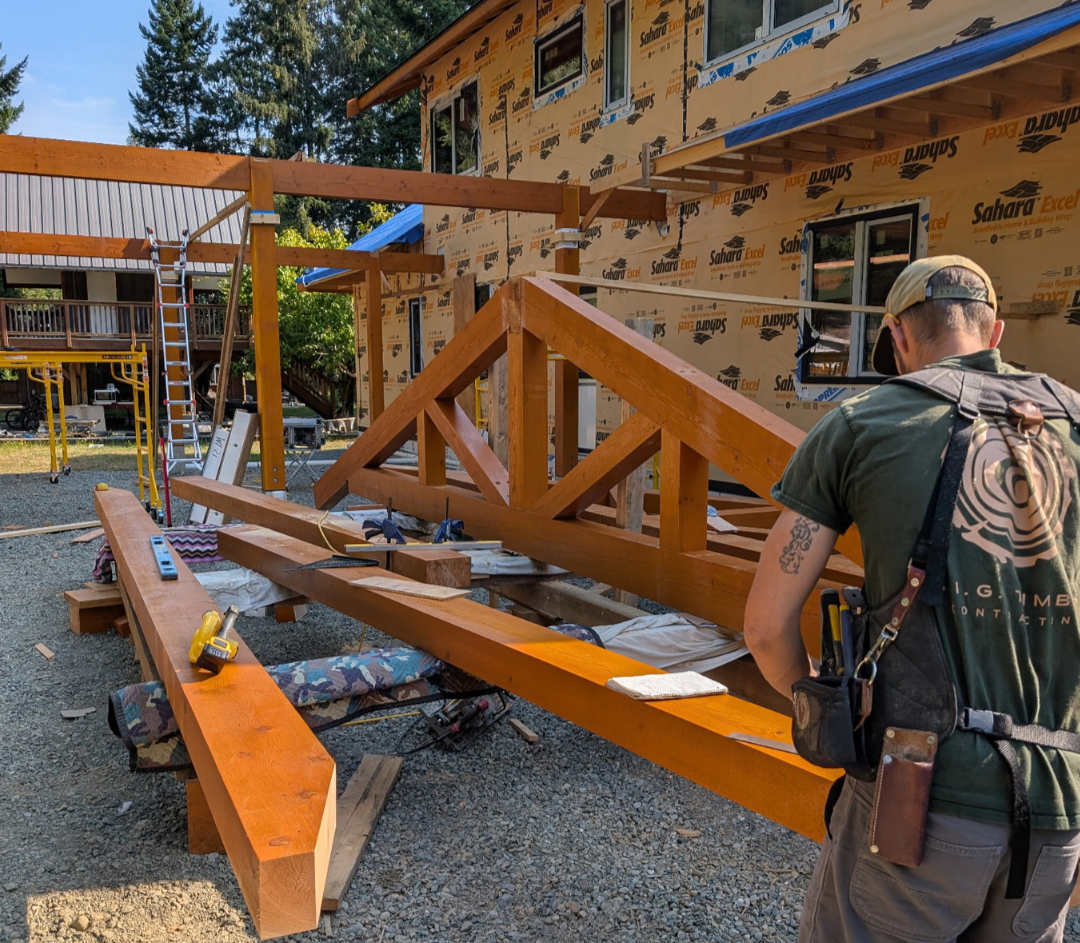
Why Our Carpentry-Led Approach Matters
At B.I.G. Timber Contracting, we’re general contractors who perform the carpentry ourselves.
Our crew is directly involved in the physical construction — from structural framing through to finishing work — while coordinating the other trades required for the project.
Our hands-on involvement means we're thinking several steps ahead. When framing a bathroom, we're already considering what the plumber, electrician and tile setter will need. When installing windows or exterior finishes, we're thinking about how flashing, waterproofing and the surrounding materials work together.
That understanding helps us coordinate the trades, catch potential conflicts early and make decisions that consider the finished project—not just the task immediately in front of us.
Not every renovation requires full general contracting services. But as a project becomes more complex, the value of experienced coordination becomes increasingly important.
Before you begin: Ask who will be responsible for coordinating the trades, keeping the project on schedule and communicating with you throughout construction. A good general contractor should have a clear process for managing the work, providing updates and addressing problems as they arise.
6. Make Decisions Before They Become Delays
Some renovation decisions can wait. Others affect work that needs to happen weeks before the finished product is installed.
A wall-mounted vanity, for example, may require additional framing support. A shower system affects plumbing locations and waterproofing details. Custom cabinetry may need to be ordered well before the room is ready for installation.
An experienced general contractor knows which decisions affect the construction sequence and helps homeowners make them at the right time.
Rather than expecting you to understand every dependency, they should explain what needs to be selected, when it needs to be confirmed and what happens if a decision changes.
The CHBA’s homeowner renovation guidance encourages planning finish selections in advance and maintaining regular communication with the contractor.
Before you begin: Ask how your contractor plans ahead for material selections and key decisions. A good general contractor should guide you through what needs to be decided, when those decisions need to be made, and how they affect the construction schedule.
7. Choose Clarity and Communication, Not Just the Lowest Quote
The Lowest Quote Isn’t Always the Best Value
When comparing renovation estimates, it’s natural to look at the bottom line. But before choosing the lowest number, make sure you’re comparing the same work.
Does each estimate include the same materials, site preparation, subcontracted work and finishing details? Are allowances realistic? What happens if concealed damage is discovered or the scope changes?
A lower quote isn’t necessarily a bad quote. But it isn’t necessarily a better deal, either.
At B.I.G. Timber, we’re not trying to be the cheapest general contractor.
Our focus is on doing the work properly, communicating clearly and taking responsibility for the project from planning through construction. Our carpenters are directly involved in the work, and we provide detailed estimates and invoices so clients can understand where their money is going.
We believe homeowners should know what they’re paying for, what decisions remain outstanding and how changes will affect the project.
The CHBA recommends written renovation contracts that define the work, payment terms and procedures for changes. Clear documentation gives both homeowners and contractors a better framework for managing unexpected developments.
Before you begin: Compare what’s included in each estimate, not just the final price. Ask how changes are documented, how additional costs are approved and who is responsible for managing the work.
Renovations Can Feel Easy. That Doesn’t Mean They Are.
Behind a well-managed renovation are hundreds of decisions, moving parts and details that homeowners may never see.
There are trades to coordinate, materials to order, inspections to arrange and unexpected conditions to resolve.
The work itself isn’t always straightforward. But the experience of renovating your home doesn’t have to feel overwhelming.
With thoughtful planning, clear communication and an experienced team managing the details, you can stay informed and involved without having to manage every part of the construction yourself.
At B.I.G. Timber Contracting, we bring hands-on carpentry expertise and project management together to make that possible.
Planning a renovation in the Comox Valley or Campbell River? Explore our home renovation services or get in touch to tell us what you’re planning.